
Walk through almost any residential neighbourhood in parts of Europe today, and you’ll see them: short lengths of fiber cable protruding from the ground near homes, waiting to be connected. At first glance, they look harmless—just another temporary artifact of construction. But come back six months or a year later, and many of them are still there. Some are bent, cut, or missing entirely. Others have simply been stepped on so many times they’re no longer usable.
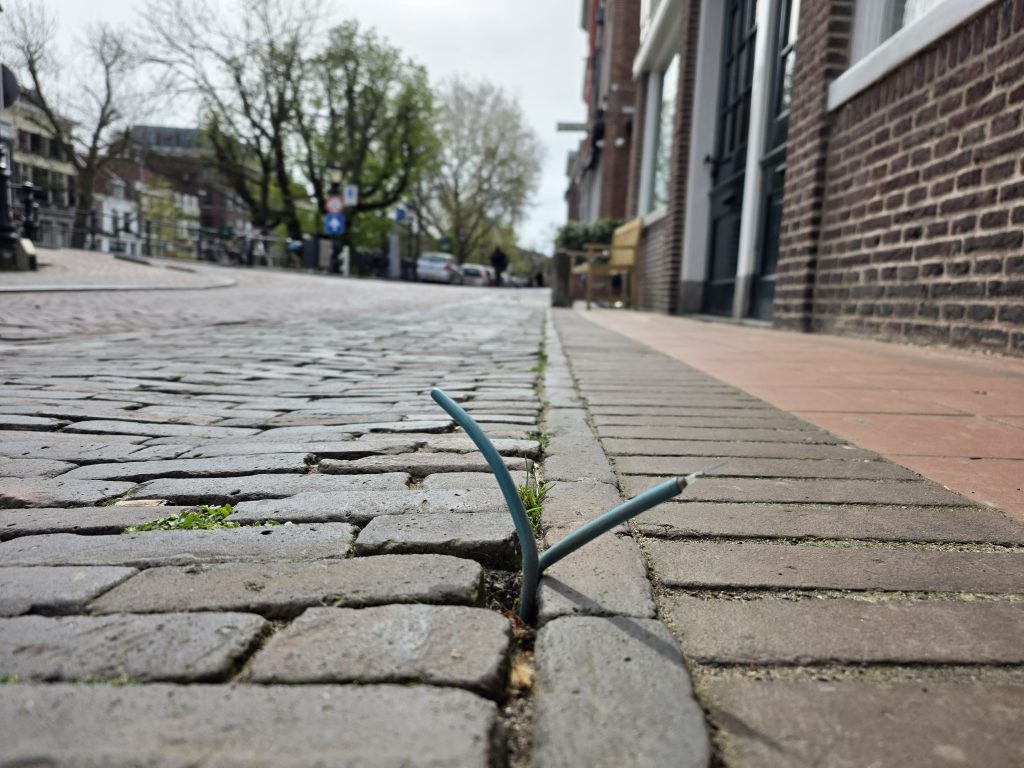
This is more than a minor nuisance. It’s a visible symptom of a deeper issue in how fiber rollout programs are being executed, and it carries real financial and operational consequences.
A System Designed for Speed, Not Completion
The root of the problem lies in how modern fiber deployments are structured. Most projects are divided into distinct phases: civil works, cable installation, splicing, and finally customer activation. Each phase is often handled by a different contractor, working on different timelines, under different incentives.
Civil crews are measured on meters installed. Activation teams are driven by customer demand. Between those two realities sits a growing backlog of “installed but not connected” drops. The fiber stubs visible at street level.
In theory, this approach maximizes rollout speed. In practice, it creates gaps. When installation and activation are separated by months, exposed assets are left vulnerable, undocumented, and often forgotten.
The Cost of Leaving Work Half-Finished
What appears to be a small operational inefficiency quickly scales into a measurable problem.
Field experience across multiple projects suggests that 10–25% of exposed fiber drops sustain damage if left unprotected for extended periods. On a rollout of 10,000 homes, that translates to 1,000–2,500 repairs. At a typical repair cost of €150–€300 per visit, the rework alone can reach €150,000 to €750,000.
And that’s just the direct cost.
Disconnected drops also drive repeat site visits. In many cases, the initial installation is followed by a second visit months later for activation. Even without damage, that second mobilization costs €80–€150 per home. If half the homes require it, that’s another €400,000–€750,000 per 10,000 homes in avoidable operational expense.
Beyond cost, there’s a productivity impact. Crews spend valuable time revisiting completed areas instead of progressing new work. On large programs, these inefficiencies can consume 15–25% of available field capacity.
Delays, Data Gaps, and Lost Visibility
The problem doesn’t stop at physical damage. Long delays between installation and activation—often three to twelve months—create significant data challenges.
During that time, project records become fragmented. Contractors submit reports in different formats. Installed assets are not consistently tracked against their activation status. In many cases, operators struggle to answer a simple question: Which homes are actually ready for service?
This lack of standardization complicates billing, slows down invoicing, and introduces risk into progress tracking. It’s not uncommon for utilities to deal with inconsistent reporting across contractors, making reconciliation both time-consuming and error-prone.
At the same time, exposed cables create safety concerns and erode public confidence. Residents see unfinished work lingering for months, raising questions about quality and accountability.
Why It’s Happening Now
The issue is particularly visible in Europe because of the scale and speed of current fiber rollouts. In countries like Germany and the Netherlands, multiple operators are racing to build networks simultaneously. Labour shortages, especially for skilled splicing and commissioning, further stretch timelines.
Under pressure to expand coverage quickly, programs prioritize installation over completion. The result is a growing inventory of partially finished assets sitting in the field.
Moving Toward Better Practice
This situation presents both a challenge and an opportunity. The problem isn’t unsolvable. It’s largely a matter of coordination, standards, and visibility.
First, temporary protection must become standard practice. Simple measures like capping, coiling, or housing exposed drops in small enclosures can reduce damage rates by more than half. These are low-cost interventions with immediate impact.
Second, phases need better alignment. While full integration of installation and activation may not always be feasible, reducing the gap between them—even to a few weeks—can significantly lower both rework and repeat visits. Incentives should reflect not just installation volume, but time-to-activation.
Third, real-time field visibility is critical. Capturing the exact location, status, and condition of each drop at the time of installation allows teams to track progress accurately and plan follow-up work efficiently. When supervisors can review field data remotely—through photos, scans, or GIS updates—they can reduce unnecessary site visits and catch issues early.
Finally, standardizing reporting across contractors is essential. Consistent formats for daily quantities, locations, and asset status simplify billing and improve data quality. It also ensures that all stakeholders are working from the same information.
A Small Detail with Big Implications
At first glance, a fiber stub sticking out of the ground might seem insignificant. But multiplied across thousands of homes, it becomes a clear indicator of inefficiency in the system.
For utility professionals, especially those on the civil side, the takeaway is straightforward: incomplete work is expensive. Reducing exposure time, improving coordination, and capturing better data are not just operational improvements. They are essential steps toward delivering infrastructure at scale, efficiently and professionally.
In an industry racing to build the networks of the future, finishing the job properly may be just as important as starting it quickly.
